The coverage
Verdict
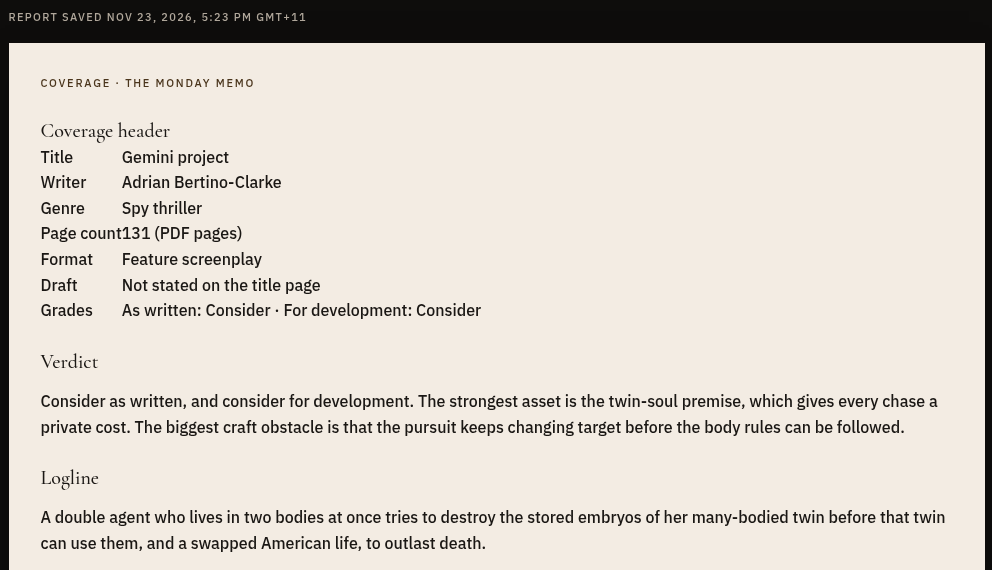
Consider as written, and consider for development. The strongest asset is the twin-soul premise, which gives every chase a private cost. The biggest craft obstacle is that the pursuit keeps changing target before the body rules can be followed.
Logline
A double agent who lives in two bodies at once tries to destroy the stored embryos of her many-bodied twin before that twin can use them, and a swapped American life, to outlast death.
Synopsis
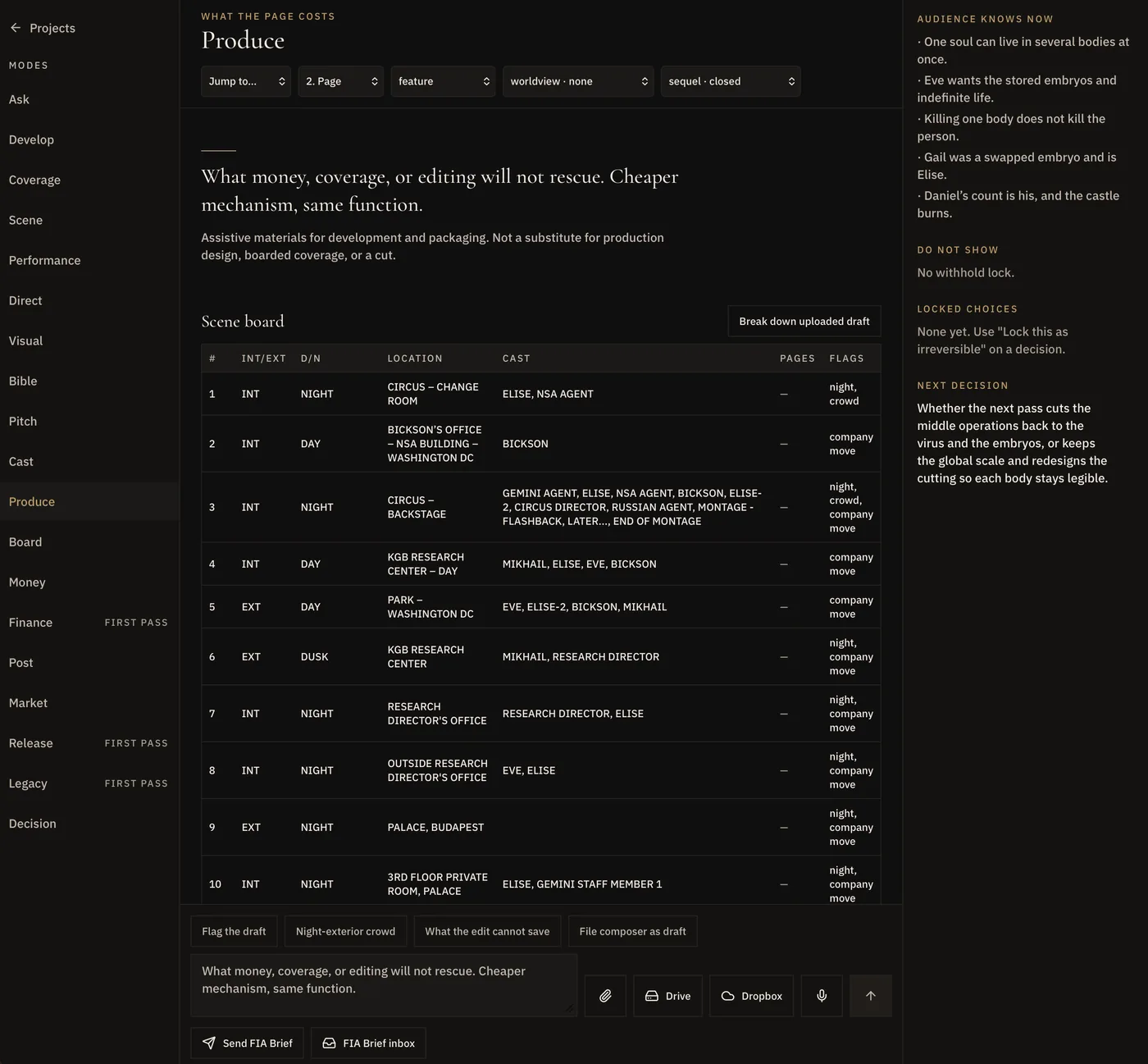
At a sold-out Moscow circus, Elise, twenty-seven, performs as a clown while she works for Mikhail's clandestine Gemini operation and for Bickson at the NSA. She takes a flash card from a Hungarian virus trader, copies it, and keeps the original. Her identical second body reports the Budapest date to Bickson, then hands that card and the date to a Russian agent. In voice-over she says she has two bodies and one soul. A flashback shows the defunct KGB experiment Gemini, in which one fertilised egg became sixteen identical siblings. Mikhail had six implanted and the rest stored. Elise says that of those six only she and Eve exist, and that Eve has five of the bodies. She also says that, two years after her birth in Russia, she was born to an American couple who did not know what she was.
In the present Mikhail orders Elise to kill the Hungarian and take the rest of the virus before it is sold to the Chinese. The Research Director tells her that Mikhail still holds embryos of her and of Eve, and that only Mikhail can reach them. Elise says she will destroy those embryos even if it kills her. Eve would rather take them for money, power and a life she calls eternal. Elise calls indefinite life something else.
On 3 October in Budapest the exchange breaks into a fight among Russians, Chinese and a CIA team that Bickson did not expect. A helicopter explodes. When a woman answers Mikhail's phone, his apartment blows up. Elise swaps the real chip for a fake. Eve stashes the money. Elise throws Eve the cylinder and hides the chip. The Research Director tells Elise that Mikhail is dead. He tells her to reach the reporters and to check her email. In the palace car park Eve shoots Elise in the back of the head. With Bickson, Elise's other body feels the shot and thinks she is dead. Eve kills the Research Director, then destroys the research centre.
In a Washington hospital a doctor says the bullet only grooved her skull. Elise finds the chip already in CIA hands, with Jack Beardmore. An email from the Research Director sends her toward Zurich and breaks off at the letter E.
Eve buys a chateau on Lake Lugano. Beardmore plans to have Elise impersonate Eve. Elise tells him that constant pain confuses Eve, and that otherwise he should shoot to kill. He brings her into CIA training as Elise Bradford of ASIO. Eve then sets Solomon to splitting embryos, and turns him to cloning when the split fails. Through Leo Sarks and a hacker she uses the Hungarian's virus to steal seven hundred and fifty million dollars. She has two clone embryos implanted in a young maid who does not know she is pregnant.
In Miami one of Eve's bodies is brought in from the airport, and Elise shoots her. Another of Eve's bodies destroys the office from a helicopter. Elise has to tell Beardmore again that Eve is one person. The hunt moves to Lugano. A CIA watcher is killed on the mountain road. Before the household leaves, Eve reads a Gemini file that records embryos marked E swapped for the Armstrongs and for a French family, the Puvillands. Elise and Daniel find the house empty. A shot drops one of Eve's bodies into Daniel's arms. In another body, Eve, sick with her pregnancy, phones an order: "Kill her!" Elise arrives with the gun and says that was Eve. Eve later demands the pregnancy be ended, because she concludes that the embryo is Elise's and that she is becoming Elise's mother.
Beardmore offers Eve a deal. Her price is her sister, dead. On a flight Elise convulses and tells Daniel that the embryo being aborted is her, the same soul in another body. Their plane is destroyed, and they parachute into the Alps. Eve's people kidnap General Mark Armstrong, his wife Pauline and their daughter Gail from a beach house in Spain. Daniel refuses to leave her. In Zurich Elise collects cash, guns and false papers the Research Director left her.
At Eve's castle the Armstrongs are tortured for submarine codes. Elise and Daniel go in with mercenaries. Eve copies Elise's appearance, hides the beauty spot, and leaves the wounded Elise for Daniel to shoot. He does. Gail, dust-covered, kills that Eve and tells Daniel she is Elise. She says that years ago Mikhail swapped the Armstrong embryo for one of hers. She tells her parents. Snow falls on her skin and she does not shake it off. At headquarters Beardmore's security card fails, and he and Agent Roberts are taken away. At sunrise, in a Navy helicopter, Daniel tells Gail not to worry: Eve is dead, he counted. Gail smiles. The castle explodes. She cuddles into him while Mark and Pauline watch.
Overall assessment
The draft's best scenes make the premise physical rather than explanatory. At the circus, one Elise copies the card while the other walks out with the date, and the cut itself shows how a single person can betray both sides in the same minute. Later, a doctor's jerk of a sore neck is felt by the body in San Diego, and a head shot in Budapest lands as a shock in Bickson's office. Those crossings give the love story and the pursuit a cost no ordinary twin thriller has. Daniel's mistake in the basement can be played as grief, because the pages have already let him trust the wrong mark.
Three craft problems stand between this draft and a draft a buyer could follow. Bodies multiply faster than the scenes can identify them. The pursuit changes target too often. The Gail reversal arrives with more explanation than preparation. Closing that gap wants a substantial rewrite that keeps the premise, Elise, Eve and the embryo threat, and throws out pursuits that do not serve them. It does not want a new idea.
Story and structure
Elise's objective, stated to Eve outside the Research Director's office, is to destroy the stored embryos. Eve's opposing objective is to keep them, implant them, and prolong one life across many bodies. The central contradiction is that the same split which makes Elise a perfect spy also makes her unable to live as one person, while Eve treats that condition as a fortune. The film is built as a chase whose real turns are not the handovers but the moments when one body feels what another body suffers.
The opening plants both the espionage job and the private rule. Elise's voice-over says two bodies, one soul, and that she may answer in the wrong body. The flashback then gives the arithmetic she believes: sixteen siblings from one egg, six implanted, Eve with five bodies that she knows of, herself the different one. The Budapest night is the first large reversal. Elise completes the theft, then a shot she expected to end one life is felt, and survived, in another. From there the story alternates Eve's attempt to restart the experiment with Elise's attempt to stay inside Beardmore's operation without giving herself away.
Who knows what is staged as a series of gaps the audience is let across before the characters are. The audience sees two Elises, and Eve's numbered bodies, while the CIA Director still has nothing on Gemini. Bickson alone, Elise says, knows her secret nature. Eve believes Elise dead from the van until the Miami shooting proves otherwise. Beardmore is told the many-body rule and still acts as if killing one body finishes the person. Daniel is told the embryo rule on the plane. The Armstrongs are not told until Gail speaks to Mark outside the castle.
The major plants are the stored embryos, the beauty spot, the American placement, and the file Eve later reads: embryos marked E swapped for the Armstrongs and the Puvillands. The Zurich box pays the Research Director's promise of help. The castle pays the swap, at least for Gail. The ending answers the opening image of a woman living two lives in disguise: Gail tells Daniel that, for the first time, she is free, and then stands in one body, in the snow she once could not bear. Daniel's count, and her smile, leave the larger tally where Elise's own phrase left it.
Characters
Elise carries the film. Her objective is clear, and her change is from a woman begging Bickson for a permanent break to a woman who chooses one life and tells her American parents the truth. An actor can play the exhaustion of hearing two places at once, and the tenderness with Daniel, without softening the spy. Eve is a strong antagonist because her want is the same biology turned outward: she offers Elise the embryos, is refused, and then spends the rest of the story becoming her own mother. The cruelty is consistent. What is less clear is any private cost to Eve beyond rage when a body drops.
Daniel is the audience's way in, and he has a clean arc from sceptic to the man who shoots the wrong woman and has to live with it. His appeal is the lightness, the hotel comedy, the refusal to leave. Beardmore is vivid as appetite and career fear, and his fall at the card reader is a satisfying button, though his motive for dealing with Eve stays thinner than his behaviour. Bickson is the moral parent Elise actually trusts. Gail, Mark and Pauline matter most in the last movement. Tanya and Solomon carry the science argument and then are taken away by the Marines, their story finished enough for supporting roles.
Theme and tone
Beneath the pursuits, the draft is about whether a person is a body count or a soul, and whether wanting more life excuses what you do to get it. Elise's line to Eve, that deeds matter, is the argument the basement is built to test, and Daniel's shot is the test she does not get to answer in words. The tone holds as a romantic spy story with a theological streak, earnest about God and souls in a way many thrillers would dodge. Comedy at the hotel and at Eve's dinner table is a release, not a contradiction, until the torture of the Armstrongs asks for a gravity the surrounding quips do not always grant.
Development notes
The hardest problem for viewers is knowing which body they are with. The pages are serious about the rule: Elise hears Bickson during Mikhail's briefing, feels the hospital Doctor's jerk in the other room, and feels the embryo on the plane. That design is a choice, and it is the right one. What viewers experience, though, is a run of near-identical red-haired women in wigs, numbered only in the action lines, often in two countries at once. When Eve-4 says she is two down and the Research Director asks if only one of her is left, the staff then report a different remainder, and later Elise tells Daniel three remain, then two. Those lines can sit together if each speaker knows less than the story, and Elise's own phrase "that I know of" keeps a hidden body possible. Viewers are not given a simple way to hold that. The treatment is to keep the uncertainty, and to give the reader, in action lines, one stable marker per body for a scene: hair, spot, place, wound. On screen, repeat the spot and the necklace as things characters check, the way Daniel already checks a mark in the basement. You would lose some of the giddy scramble. You would keep the rule.
The pursuit changes target so often that the embryo vow has to compete with a virus, a bank theft, a Libyan photograph, a CIA leak Elise is told to find, and a submarine sale Eve later calls a prank. Each of those is on the page, and the prank line does reframe the Beirut meeting and the castle codes as a lure for Elise. The trouble is that the lure is staged as a real nuclear deal for a long stretch, and the correction is one sentence to Daniel after he has shot Elise. A first viewing experiences a cancelled thriller, not a trap springing shut. Fold the virus into the means Eve uses to fund the embryos, and plant the submarine as bait when she tells the Operations Manager to leak it, with Elise suspecting the shape of the trick before the castle. The leak inside the CIA can die with Beardmore's arrest if one line ties the Niagara rumour to the deal he offered Eve. What you give up is the sense of a worldwide conspiracy. What you gain is one chase.
Gail's reveal is prepared more than it first seems, and it is still too late to land cleanly. The file names Armstrong. When Eve then searches for Armstrong, the photograph she finds shows a daughter who looks like Elise. In San Diego a woman calls "Gail" while Elise's second body is in the garden. At the beach house Gail bites her lip, wears a crucifix turned backwards, and hears the abduction with a calm the pages do not explain. Those are plants, not accidents. Viewers still meet Gail as a victim for only a few minutes, then receive a confession that has to do the work of a story. One scene before the kidnapping, in which Gail acts on knowledge only Elise could have, would let the basement be recognition rather than a lecture. The confession can stay. The surprise becomes sharper if the audience is half a step ahead of Daniel and still not ahead of the Armstrongs.
Daniel's shot is the emotional centre, and the staging blurs the trick it depends on. In the yard, Elise burns her left forearm with a hot bullet casing and shows Daniel the mark as her tag, while Eve watches from the dark. In the basement, Eve copies Elise's hair and points to a cheek with no beauty spot; Daniel checks her left arm, sees the mark and accepts her. He shoots the trapped woman. The pages support a deliberate deception: Eve saw the tag being made. They never show her copying it, though, and both women are also wounded in the left shoulder, so viewers can easily think the script has simply mixed the two women up. Show Eve copying the mark, even in a single insert, and let Daniel's check play in a held moment. Keep the shot. It is the price of his not being able to tell her apart, which he has already admitted at the chateau.
The young maid's pregnancy is introduced with force and then left in the room. Eve orders the two clone embryos implanted, the maid is told she has a growth, and Solomon is shocked. No later scene says whether the pregnancy was ended, brought to term, or was never Eve at all. Because those embryos are clones from stem-cell nuclei, not the original split, the film's own science does not require them to be Eve or Elise. Leaving them unresolved is coherent only if a line tells the audience that this experiment failed, or that Solomon refused it. Without that, the implantation sits as a cruelty the story starts and forgets. A short result, even offstage, would close it. Cutting the implantation would spare the film a classification problem, and would also spare it a second science it does not need.
Production and market
The pages imply a large studio action picture: Moscow, Budapest, Washington, Boston, Miami, Lugano, Beirut, Spain, a castle, helicopters, a submarine unit and several large blasts. The cost sits in travel, aerial work, destruction, and the twin photography, not in a single star. Viewers who came to The Bourne Identity (2002) and Face/Off (1997) are the likely audience, adult and thriller-led, with a taste for romance inside the pursuit. A buyer will notice that the draft runs 131 pages, longer than the 90 to 120 pages most spec features are read at. The non-consensual implantation of the maid, the sexual pressure Beardmore puts on Elise, and the torture of the Armstrongs, including a hammer and electric shock, are classification and taste risks a financier will flag.
Next draft priorities
- Give each body a stable marker in the action so the crossings can be followed, which is the identity problem in the notes.
- Reduce the pursuit to the virus as money and the embryos as the prize, and make the submarine bait early.
- Prepare Gail in one scene before the kidnapping so the basement confession is recognition.
- Show Eve copying Elise's burn mark before the basement, so the shot reads as his mistake, not a mix-up of the two women.
- Close the maid's pregnancy in a line, or cut the implantation.
What must not be changed is the openness the writer has already left: whether Eve's body count is finished, whether another swapped child exists, and whether every stored embryo is destroyed. Daniel's "I counted" should stay qualified. Nothing in a rewrite should add a shot that settles those three.
Left unresolved in the draft
The French name in the same file line as Armstrong, Puvilland, is never taken up. Because the Armstrong swap is shown to be real, the unread twin entry can sit as another possible child without a scene of its own. The Research Director's email breaks at "E_", and the Zurich box later supplies papers rather than a full explanation, which fits a man who died mid-warning. Bickson asks why Zurich after the visit is already under way, and the pages never answer him. That silence matches Elise's habit of acting before she explains. None of these needs a closing scene to be coherent.